Samhain: November tide, witches’ sabbath
Filaniya · 14 min read
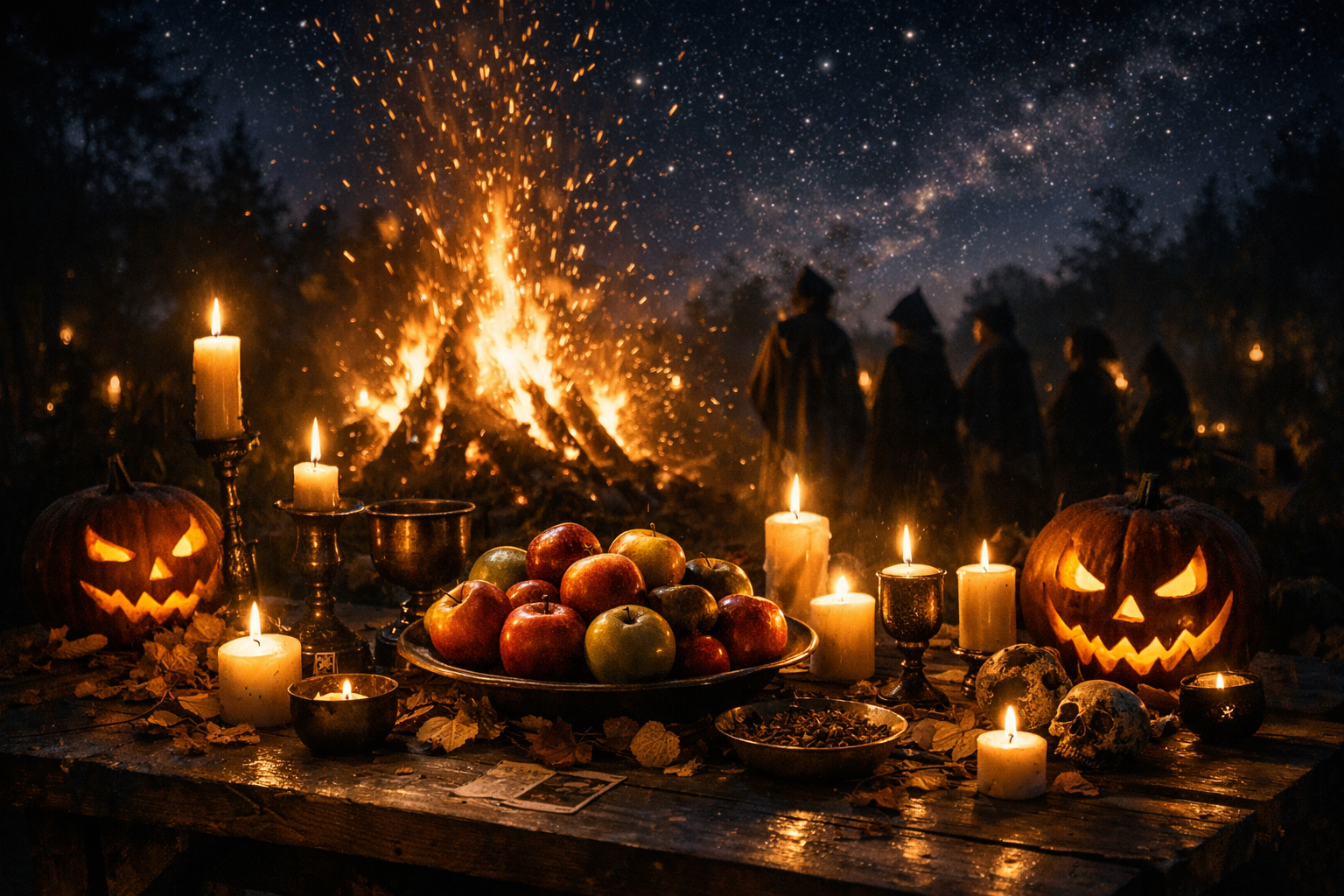
The Day of the Dead — the November Yuletide (lystopadovi sviatky) of Kyivan Rus. It is also sometimes called Samhain or Halloween: the new year by the lunar calendar, the harvest festival — the witches' greatest holiday, the sabbath. Its modern equivalent is All Saints' Day.
Its date is the eve of November, when the sun stands in the 10th degree of Scorpio — usually falling between the 30th of October and the 2nd of November.
The peak of the energy rise is the last full moon, the Hunter's Moon, before the first of November.
The modern equivalent is All Saints' Day, Halloween. Other names of the feast are the feast of Pomona, Apple Day, the Feast of Death, the November Yuletide of Kyivan Rus.
The patron gods of the feast are the goddess Hecate, Medea, Gwyn ap Nudd, Samhan and Cerridwen.
The feast is defined as liminal, dark, masculine.
Customs: lighting bonfires, apple games, frightening costumes, fire conjuring, pranks, carved pumpkins, magical rites of Great Power, scorching of stones.
Symbols: photographs of the dead, pumpkins, threshed sheaves of grain, Saturn, poisonous herbs, skulls, black cats and witches, fear, awe, the tambourine, pomegranate, nuts, acorns.
Sacred food: apples, red meat (beef, mutton), red wine (absinthe), root vegetables, climbing vegetables (pumpkins, peas, beans, turnips, parsnips and so on).
Incenses: wormwood, nightshade, hemp, burning apple branches.
Sacred plants: wormwood, thistle, chrysanthemum, broom, sage, oak leaves.
The sabbath is celebrated on the night of the 31st of October to the 1st of November, with its culminating point at midnight.
Samhain differs from what is now called Halloween and celebrated in nightclubs. The symbolism of the feast is such that if there is joy, it is calm; if knowledge, it is hidden; if beauty, it is unique to this season. On Samhain night the Horned God falls asleep in the arms of the Goddess and leaves this world, leaving the world in stillness for almost two months.
We mourn the God, treasuring His gifts, so generously bestowed upon us this year, and His lessons. We should thank the Gods for the strength they gave us to live through the departing year. This is no time of mourning — it is a time of inner peace, inner stillness.
Only in this state can the veil between the worlds be lifted. We may call those who were dear to us and have left us. Often, as Samhain approaches, they begin calling us from the other side. We feel the need to remember our loved ones, those who are no longer with us.
We keenly miss our own footprints on the road of past incarnations, and on Samhain night we set out on journeys through time to remember ourselves.
Its symbols are the pumpkin with a candle lit inside. The pumpkin embodies the head of the Blessed Spirit.
The whole harvest is already gathered from the kitchen gardens, and it is time to burn the withered plant stalks. On this day people customarily ate potatoes, red wine, red meat, carrots, pumpkins, apples.
At this time the veil between the worlds grows so thin that mages and supernatural beings can pass from one world to another without hindrance.
The Night of Spirits is the night from which the last drop of time flows out, and no day comes after it. But the very sound of the snapping, bursting string that sang all the previous year — that is what resounds on the night of this sabbath.
We listen to the silence of the Other World that night. And we spend it alone, in reflection upon the dead.
Kin. There is no need to suppose this means only departed relatives — it is all those who dwell beyond the border of this time-space. This time they can be seen, and spoken with.
On this day offerings and sacrifices to the dead were obligatory, for it was believed that otherwise they would cross the border between the world of the living and the world of the dead and start sowing evil.
This bond with the world of the dead is tied to the fact that early November brought the hardest season for people — winter; nature, as it were, died.
On this night there also took place the so-called Wild Hunt — a perilous magical trial in which the mage competes with the elemental spirits. If they lose, they pay with their own life; but if they win, they gain, as ever, a fair measure of uncommon abilities and secret knowledge. Not every mage dares such a trial, for it is considered very dangerous.
The myths of Europe unanimously say that on the night of the 1st of November (or thereabouts) a great and gloomy procession sweeps across the world. Much has been written of the Wild Hunt, legends and lore alike. But it is the same fire dragon, the same Zmiy Horynych (the many-headed serpent of Slavic tales) as in Rus.
The common name — the Wild Hunt — is found everywhere: Wild Hunt, Die Wilde Jagd, Wilde Heer, but there are also many local and later names, such as the Welsh Cŵn Annwn (the hounds of Annwn), Herod's hunt, Cain's hunt, Gabriel's hounds, Asgardreia and the like. In every land where this legend occurs it has transformed, adapting to local beliefs, and the nuances in describing the Wild Hunt are countless. Originally the Wild Hunt was a pack of white dogs with red ears (the characteristic colours of Otherworld beasts — e.g. the white red-eared cows giving very thick and foamy milk, a traditional bone of contention between humans and elves in late Irish, Welsh and Scottish legends). These hounds are guides from the upper world (albio) to the lower (dumno) — hence Albion. They belong to Arawn, ruler of Annwn. The leader of the Wild Hunt may therefore be called Arawn himself.
The Wild Hunt may be witnessed at any time. But most often it appears on days of Timelessness, of liminal, borderline states. The brightest example is the first full moon after Samhain. The year's end, yet not the new year's beginning; the equinox; the moon no longer waxing, yet not yet waning. Another example is Beltane. On other days the most favourable time is twilight. The border between the worlds of the dead and the living grows altogether thin, and crossings may happen even against the will of people or spirits themselves. Sometimes in dreams.
There are several less substantial readings of the Wild Hunt. It is held that the druids, knowing the moments most favourable to its appearance, summoned it deliberately. Special rituals and an infusion of mandrake root were used for this. As a rule it was done at the first full moon after Samhain. Having summoned the Wild Hunt, they entered into a certain situational-logical duel with it. If the druid stayed alive, he rose higher in the priestly hierarchy and gained a further magical capacity for contact with the realm of the dead.
The Wild Hunt is described as having many leaders, men and women alike. In some accounts of the Wild Hunt it is stated directly or indirectly that a god leads it; in others the leader of the Wild Hunt is a human — or rather, a former human. A cavalcade of huntsman-ghosts on horseback, with dogs.
The Wild Hunt also traces its origin to Norse and Teutonic mythology. On stormy nights the god Odin rides across the sky at the head of horsemen, with a pack of barking dogs. His retinue races across the earth, feasts and strews rubbish. Whoever, to their misfortune, meets them is carried off at once to another land. And whoever is foolish enough to speak to them is doomed to die.
In the lore of northern Germany their leader is the woman Holda (Holde, Hulda, Holle and Holte) — goddess of the hearth and motherhood. In southern Germany she is traditionally called Bertha (Berchta, Perchta) — the name under which the Norse goddess Frigg is known. Bertha means the shining one. She is bound to the moon and guards the souls of unbaptised children. Bertha's bond with the moon led to her identification with Diana, the Roman goddess of the moon, so Diana too may head the Wild Hunt. Her night watch punishes the lazy and the wicked — but if food is left before the doors, they eat it, and then it appears again before they move on.
After the Reformation and the Protestants' abolition of Purgatory, the Wild Hunt became the lot of the unbaptised dead, especially children. The unbaptised could not be buried in consecrated ground; they were buried in the northern part of the churchyard, where, it was believed, they remained beneath the earth. They became sport for the hounds of the Wild Hunt, which drove them into hell.
The Wild Hunt exists in English lore too. There the procession is headed by Henry the Hunter — or simply the devil.
As Christianity spread, the pagan gods were demoted to demons and the devil. In the days of the witch hunts of the Middle Ages and the Renaissance it was believed that the Wild Hunt's retinue included not only the spirits of the dead but witches too, and that it was headed by Hecate, the Greek goddess of the dark side of the moon, patroness of witches.
The Cornish variant of the Wild Hunt is Dandy Devil's dogs, racing over the earth or above it, hunting the souls of people.
Twelfth-century documents say the huntsmen number twenty to thirty, mounted on black horses and black stags. With them are black dogs with terrible gleaming eyes. From Polissia to Samhain in England, monks hear the sounds of the hunt all night — dogs barking, hunting horns blowing.
The latest reports of the Wild Hunt date to the 1940s — it swept across the Samhain expanses on the eve of every church feast. Witnesses were advised to fall face down upon the earth and read prayers, to save their souls from the jaws of the hellhounds.
The 31st of October is the day the verge between the living and the dead grows thin. At this time the sun god dies, and the reign of the world passes to the lord of death — the Master of Winter. As he crosses from the world of the dead into the world of the living, a breach opens between the worlds through which the dead come to visit the living. The powers of darkness enter our world too, and so that they, together with the souls of enemies, do not recognise people and harm them, people dress in frightening masks.
More precisely, this does not happen in a single second — it lasts a whole week.
The full-moon night was called by the Celts the Night of the Wild Hunt. They described it thus: On this night there appears on horseback a rider from the Glass Island with his dread pack of hunting dogs, and before him the host of the Underworld...
The best Halloween rite, at full moon, is the Wild Hunt rite in the forest. It is a duel in the forest with the forces of nature. If the person wins in the night forest, the ground on which they competed passes to them for their use until the end of their life. If the forces of nature win and the person stays alive, they will serve them to the end of their life.
The point to be reached for the rite to count as complete;
The time allowed for the rite (from sixty minutes until morning).
For three days before the rite you must come to the place where the rite will begin and, lighting a fire, bring sacrifice to the spirits of nature.
In that time you must establish contact with the spirits and agree the terms of the rite. The spirits may ask for some specific sacrifice.
Animal sacrifices, or sacrifices involving blood, are not recommended. Use red wine instead of blood. On the appointed day, toward midnight, light a fire and burn some wormwood. The moment it burns through, start running through the night forest to the set finishing point. If the rite goes as it should, you will feel that you are not running alone — that a spirit of nature, summoned by you to the contest, runs with you. A mage can summon only an entity of their own level, so do not count on a duel with a monster you cannot overcome. The mage need not go into the forest at all, but may run virtually, in the astral.
Filaniya is now on Telegram
Open the bot